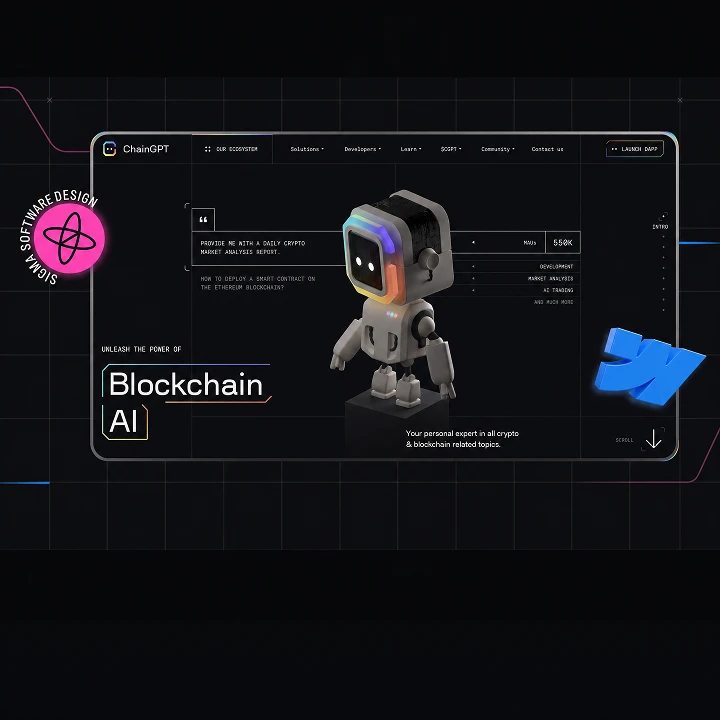
In the innovative world of Web3, things change quickly. Competition is fierce, customer preferences evolve overnight, and market trends shift in the blink of an eye. All these require businesses to iteratively refine their marketing strategies and search for ways to update on the web quickly. Traditional software development offers such opportunities, but the truth is — it can be slow and resource-heavy. That’s why scalable, modular platforms are becoming the go-to alternatives. They give companies the speed and flexibility they need to keep innovating in Web3.
Although the variety of such solutions on the market is vast, it’s crucial to pick the one that fits your goals, workflows, and long-term plans. This can be tricky if you are just starting out with these platforms. But don’t worry, we’re here to help. We’ll share a real-case story about how we helped our Client select the right solution that handles both complex designs and integrated AI tools, all while making sure the user experience is seamless.
Choosing a best-fit modular platform
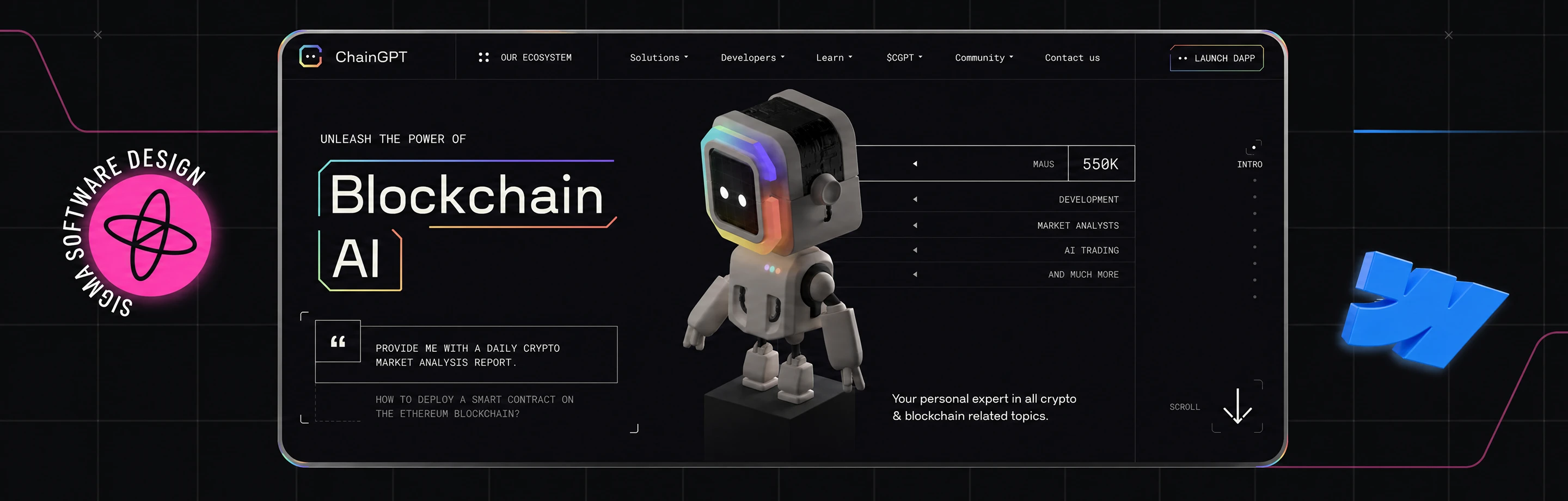
Our Client, ChainGPT — is a leading provider of AI-powered tools for blockchain and Web3. They see their mission in simplifying blockchain concepts for everyone, from beginners to pros. Hence, ChaninGPT’s product offering extends everywhere from smart contracts development to blockchain analytics, trading assistance, and beyond. The company was actively exploring ways to expand business and grow their user base and decided to start by strengthening their online presence, bringing in the Sigma Software design team to help build a distinct brand identity.
As the Client had a high-level vision of their product and brand goals, we kicked things off by analyzing a market and company DNA. Based on that, we presented a cohesive brand strategy with the new logo and core visual elements that would make ChainGPT stand out in the competitive landscape. The Web3 sector is all about innovations, so we decided to reflect that through creative and interactive 3D visuals. The Client loved the idea, so we got to work, putting the new designs across all their digital channels.
The ChainGPT website was our key focus. On the one hand, it had to maintain creative visual components and provide an immersive user experience. On the other, it needed to be easy-to-manage for the Client’s team. Based on these requirements we suggested Webflow as a backbone for a future website, as it offers two big benefits:
- Allows to iterate updates faster and more efficiently than in traditional software development
- Has a set of built-in features, which save time and cost on crafting complex designs
Yet, it was obvious that the platform still needed customizations to bring all our creative ideas to life. Hence, our team took a tailored approach to website development, blending common practices with our custom techniques to make designs user-friendly and appealing.
Tailoring Webflow to Fit Unique Designs
While using a modular platform for designing a website within the Web3 field is pretty common, adding complex 3D gamification elements is not so typical. This is largely because such features require technical adjustments that modular platforms do not support out-of-the-box. Even though it takes extra effort, we knew it was worth it as those could help the client reach a new audience. So, we went ahead and made the necessary customizations.
We also focused on making the website flexible and adaptable, so we could integrate the visuals without worrying about future updates. This way, the site stays dynamic and engaging long-term, balancing cutting-edge design and functionality. Further, we’ll describe this approach in detail and share proven tips that helped us flawlessly embody the creative designs while assisting the client in fulfill their business goals.
High Video Quality
Like with many other creative websites, videos play a key role in grabbing user attention. Yet, Webflow’s default settings are not particularly optimized for handling such content. The platform heavily compresses video files, which ends up lowering their quality when uploaded directly. Since it was planned to use a lot of videos on the website, we needed some elegant solution to keep videos looking sharp.
Here came and idea to upload videos to a third-party Content Delivery Network (CDN) and integrate them into Webflow using custom code. This approach allowed us to keep the video quality crystal-clear without any compression issues. You can check the results here.
Smooth Webflow Scrolling
There is no need to worry about scrolling on Webflow if your website involves basic design solutions. The platform offers fairly smooth scrolling by default. Yet when it comes to complex elements like interactive features, 3D graphics, or, in our case, an animated mascot, challenges tend to arise.
We decided to use the external Lenis plugin to ensure our creative solutions are displayed as planned. This library helped make animation flawless and create an immersive experience for users while browsing the ChainGPT website.

Full-quality Image Support
It’s not the best idea to download images and raster UI elements directly from Figma since it applies a strong compression to images. Instead, you may consider providing all images separately using a Google Drive folder or a .zip archive for example.
Our experts usually prepare images manually using the best possible compression to ensure quality balance. Also, we apply modern file formats like WebP to save images instead of traditional formats like PNG or JPG. All because the WebP files are smaller and load faster on the website without quality loss. The same approach we take for videos replacing MP4 with WebM.
Apart from that, there is another trick here. Once your images are optimized, it’s important not to forget to turn off the checkbox highlighted in the screenshot below. Otherwise, Webflow will apply its own compression on already compressed pictures, resulting in blurry images on screens.
Fluid Experience Across Devices
No matter what website-building platform you use, it’s important to make sure your website runs smoothly on any device. Thus, our team made the website fluid responsive, meaning it is resized proportionally according to the browser window size.
This allowed us to adjust complex grid layouts to any screen size without the usual headaches of multi-column issues or tricky resizing logic. One thing to keep in mind though — if you want to create fluid responsive designs, all font sizes should be defined using REM units instead of pixels.
Availability in Lower Power Mode
Given that ChainGPT audience often uses mobile devices to explore their services, we also had to take care of active Low Power Mode on their gadgets. When turned on, this mode disables video autoplay and, in some cases, could even completely hide it, resulting in a blank screen. So, to overcome this drawback, we’ve found a trick. When the mode is turned on, we replace the video component with a static image representing the 1st frame of the video. This way, the visual fallback still pulls users in and keeps them engaged with the content.
Key Takeaways
The tailored approach helped our design team bring the most creative ideas into life. We delivered not just an aesthetic platform but a functional and scalable solution focused on user engagement. This resulted in a Client’s traffic increase of up to 1M visitors during the first month after launch. Also, the website was recognized and awarded by industry experts.
Given that marketing trends are always shifting, finding a balance between creative freedom, technical efficiency, and scalability is key to staying ahead. That’s why your digital strategy should bring all these elements together. If you’re going with a modular platform like Webflow, just remember — it still needs some customizations to fully match your goals. However, this doesn’t mean compromising on creativity — these platforms have all the potential to support unique and innovative brand experiences.