

How digital healthcare is shifting towards clearer, more continuous experiences across patient touchpoints, and what that means for product, brand and care delivery.
Digital care is growing quickly, but the bigger design challenge is making all of its parts feel like one understandable experience.
Healthcare has already done much of the hard work of becoming digital, with appointments moving online, remote consultations becoming part of everyday care and patients increasingly managing results or follow-ups without returning to a clinic.
What we keep seeing, though, is that digital does not automatically mean simple. A fairly ordinary patient journey can still begin on one website, continue through a separate booking system and move into another portal after the appointment. If treatment follows, another service may enter the picture again. Each part can be perfectly functional on its own, while the overall experience still leaves the patient figuring out how everything fits together.
And patients, quite reasonably, did not sign up to become part-time system integrators. Across the healthcare products we see today, the same themes keep appearing in different forms. Some are already well established, while others are only starting to shape how teams think about future products. Together, they give a useful picture of where healthcare experience design is moving.
What we’re seeing now and where it’s heading
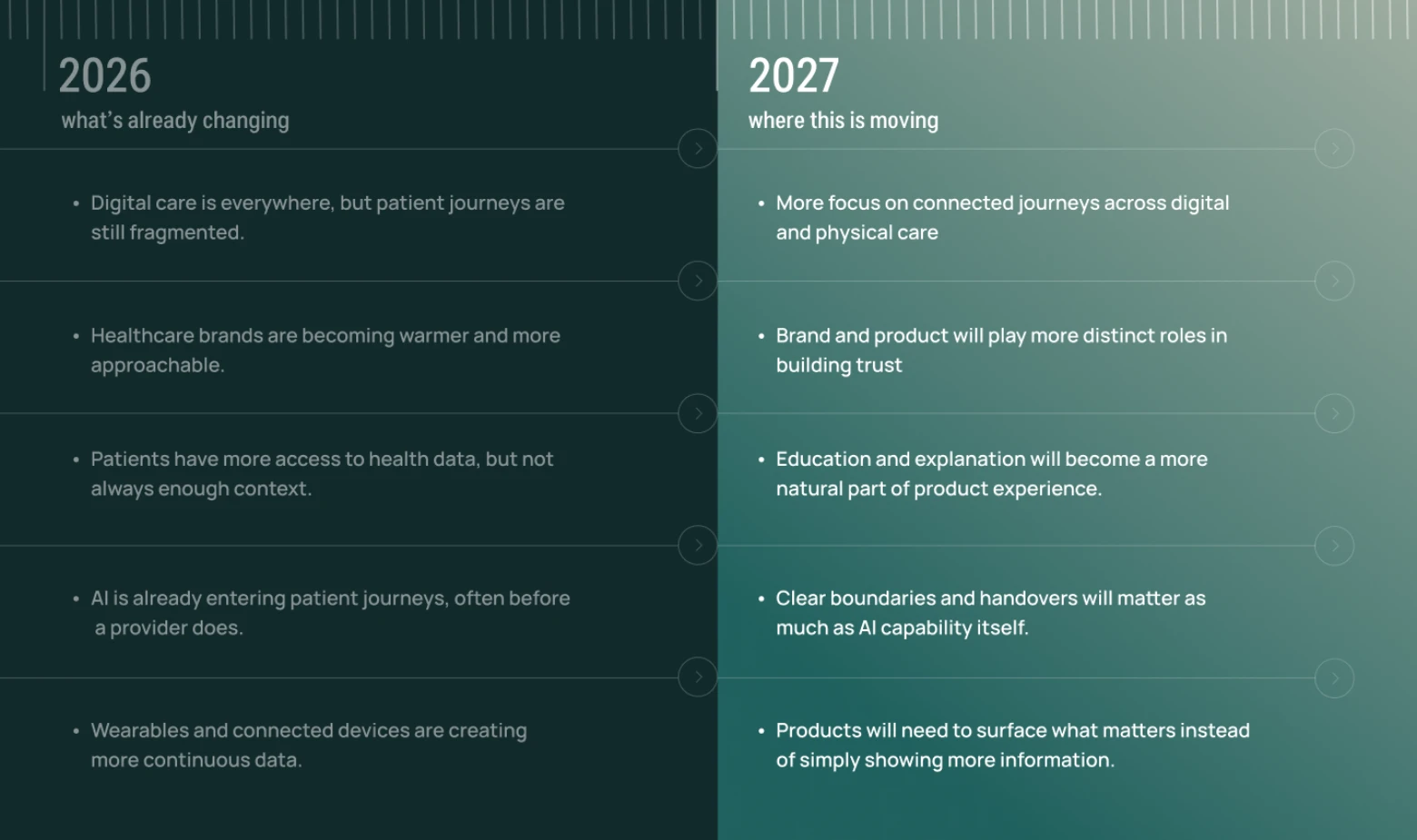
These shifts are already visible in the healthcare work we see around us and in the wider market. Some are becoming standard practice, while others are still taking shape, but they all point in the same direction: healthcare experience design is moving beyond individual screens and towards a more connected patient journey.
Patients now notice the experience before they experience the care
People do not arrive at a healthcare product with expectations formed only by other hospitals or clinics. They bring years of using digital services where much of the complexity stays behind the interface and the next step is usually obvious.
Healthcare cannot simply copy those products because the circumstances are very different. A medical decision carries more weight than ordering dinner, while patients are often already stressed before they begin interacting with the service. Simplifying healthcare therefore requires more care than simply removing as many clicks as possible.
What does transfer easily is the expectation that people should not have to understand how an organisation works internally just to complete a basic task.
This becomes visible very early in the journey. Someone may spend time comparing providers, reading about a service and finally deciding to book, only to reach a process that moves them somewhere else or asks for information they have already provided.
At that point, the issue is no longer just usability. The organisation has already invested in creating interest, which means unnecessary friction in the booking experience can turn an acquisition success into a lost patient before care has even started.
Press Ganey’s consumer research found that online scheduling influenced provider choice for 80% of respondents, while 24% said they would look elsewhere if booking was not easy enough. This is one reason the boundary between marketing experience and product experience is becoming increasingly difficult to draw.
Good marketing can bring people to the door, but the experience still has to let them in.
Healthcare is becoming warmer for a reason
Another shift is much more visible because it appears directly in the visual language of healthcare. For years, digital healthcare often borrowed the same cues as physical clinics, where formal interfaces and a distinctly clinical aesthetic were used to communicate seriousness and credibility. That still makes sense in many situations, but it can work against the experience when someone is already hesitant to ask for help.
The effect becomes particularly clear in areas such as mental health, sexual health or weight management, where the emotional barrier can appear before the patient even reaches the first form.
This helps explain why many consumer healthcare products now sit much closer to wellness and lifestyle brands. Their language is more approachable, the imagery feels more human and the first interaction is designed to reduce the feeling of entering an institutional process.
What matters more is why healthcare is starting to feel warmer and less clinical, but why. That shift can make the first step into care feel more approachable, especially when the topic is already personal or uncomfortable.
That does not mean the same visual approach should continue unchanged through the entire product. Once a person enters the actual care experience, the priorities shift because someone checking medication instructions or trying to understand an unusual test result needs certainty more than persuasion.
This is a distinction we find particularly useful when thinking about healthcare products. The marketing layer can create enough warmth to make starting care easier, while the product itself can become calmer and more focused as the user moves towards decisions that require attention.
Both experiences belong to the same brand, but trust is built differently in each of them. The first makes a promise about how care will feel, while the second has to prove that promise through clarity.
The real friction often sits between the interfaces
Healthcare UX can look deceptively good when each part of the system is reviewed separately because the booking experience may be well designed, the portal may work correctly and the telemedicine product may be perfectly usable. The friction becomes much more obvious once those pieces are viewed as one patient journey.
In 2024, 59% of US patients had health information spread across several portals, while only 7% used a tool that brought those records together. It is a useful illustration of how much faster healthcare has digitised than it has connected.
This is where the idea of a one-touchpoint experience becomes useful. It does not mean squeezing every healthcare function into one giant application. For most organisations, the technology behind care will remain distributed across different systems, and there are often good reasons for that.
The patient simply should not have to feel every boundary between them. If someone has already provided relevant information during an initial assessment, the next part of the experience should recognise that context where appropriate. After a consultation, the patient should understand whether the next step is medication, another test or simply waiting for the care team to respond. When digital care needs to move into a clinic, the experience should continue rather than reset.
The same is true in the opposite direction because an in-person appointment increasingly continues through digital follow-up afterwards. This is why experience design in healthcare is moving beyond individual screens and closer to service design. What matters is not only whether each interface works, but whether the patient can move through the whole service without repeatedly rebuilding the journey themselves.
That connection between digital and physical care will probably become even more important through 2027 as virtual services settle into a more permanent role. The question is no longer whether care should happen online or offline, but how naturally the experience can move between the two.

More information needs better context
Healthcare products are also giving patients access to far more information than they had only a few years ago, which is an important step towards greater transparency but creates a new responsibility at the product level.
Research across four US academic medical centres found that 95.7% of respondents wanted test results to remain immediately available through patient portals, even when a clinician had not reviewed them yet.
Patients clearly want access, but access and understanding are not the same thing. A person can open a laboratory report and immediately see that one value has been marked as abnormal, while still having no idea whether it requires urgent action or a routine conversation during the next appointment. The portal has technically done its job, yet the patient is left with the most difficult part of the interaction.
This is where patient education starts becoming part of experience design rather than a separate content exercise. Useful guidance works better when it appears at the moment uncertainty begins. A medical term can be explained where the patient encounters it, while a result can be shown with enough context to understand whether something has changed. In other situations, the most useful information may simply be confirmation that the care team has received the result and an explanation of what happens next.
The goal is not to make a patient portal behave like a doctor. It is to avoid presenting information in a way that immediately sends the patient somewhere else to understand it.
The same principle applies during treatment. Education is more useful when it sits naturally inside the journey and supports what someone needs to do next, rather than appearing as another PDF or knowledge centre that requires additional effort to find.
As access to personal health data continues to expand, this layer of explanation is likely to become increasingly important.

AI and connected care make clarity even more valuable
AI adds another dimension because patients are already bringing it into healthcare journeys whether providers actively introduce it or not.
Someone can now arrive at a consultation after discussing symptoms with an AI assistant and researching several possible explanations, which means part of the patient journey may have happened before they ever entered the provider’s own product.
There are obvious opportunities here. AI can reduce some of the effort involved in preparing for a consultation and can help people understand complex information afterwards. It can also take administrative work away from clinical teams when used in the right context.
The more interesting design problem is what happens when the system reaches the edge of what it should be doing.
A conversational interface can sound extremely confident even when the information underneath it is uncertain, so the transition to a clinician cannot be treated simply as a failure state. In healthcare, knowing when technology should hand over to a person is part of designing the experience well.
As these systems become more capable through 2027, the quality of that boundary may matter as much as the quality of the AI itself.
Connected devices create a similar challenge in another part of the journey. Wearables and home health technologies can collect information continuously, but more data does not automatically create more understanding.
If every measurement becomes another dashboard and every change becomes another notification, the result can quickly become more exhausting than helpful.
The useful experience is the one that helps someone understand what actually deserves attention. For a patient, that may mean recognising that something has changed enough to discuss with a doctor, while for a clinician it may mean seeing a meaningful pattern without manually reviewing weeks of raw measurements.
As healthcare moves further beyond traditional apps and websites, these smaller interactions will carry more responsibility. A notification on a watch may last only a few seconds, but it still needs to make the next step clear.
What this means for healthcare teams
For healthcare teams, the main takeaway is fairly simple: stop treating each digital touchpoint as a separate product problem and start looking at the full patient journey.
That means checking where people lose context between systems, where the service asks them to repeat work and where information appears without enough explanation to support the next step. It also means being more selective with new technology, because adding AI, connected devices or another platform only helps if it removes effort rather than creating another layer to manage.
The strongest healthcare experiences are not necessarily the ones with the most features. They are the ones where patients understand what is happening, what they need to do next and when the system will take care of the rest.
As healthcare technology becomes more sophisticated, clarity, continuity and trust are becoming the real design advantage.