
How we rethink marketing structure when markets, products, and expectations change.
Not long ago, during one of our internal reviews, our VP Dmytro did what he’s done probably a thousand times by now. He walked through the Sigma Software Design website structure with fresh eyes, as if he’d never seen it before.
After scrolling for a minute, he looked up and said: “Everything here is correct. But if you’re new, you’ll probably need a guide… and a cup of coffee… to fully understand what we actually do”
The room laughed, mostly because everyone recognised the situation immediately. Over the years our services had expanded, new industries appeared in our portfolio, and the scope of our projects had grown significantly. None of that was a problem. The company was evolving in exactly the way a healthy design organisation should.
The only catch was that a first-time visitor might need a guided tour to fully understand who we are.
And once we started noticing it internally, we began seeing the same pattern in many client projects as well.
What happens and why?
Companies evolve quickly. Products gain new capabilities, services expand, and teams begin solving problems that didn’t exist when the company first launched. As a result, the narrative that once explained the business clearly begins to lag behind the reality of the work.
That is usually the moment when marketing and design stop being just communication tools. They become part of how a company helps people understand it.
This article isn’t really about tools in isolation. It’s about how the role of those tools changes when growth, new markets, or external pressure make the existing setup feel slightly out of sync, even though nothing appears obviously broken.
We started paying closer attention to this while working across several very different domains. Some projects involved e-commerce platforms expanding their operations across new markets. Others focused on blockchain products that had matured beyond early adopters and now needed to communicate with enterprise partners. Healthcare projects often brought similar challenges, although in those environments clarity becomes even more critical because trust directly affects whether people use the service.
Despite the differences between those industries, the underlying questions sounded remarkably similar.
Teams wanted to explain complex products without overwhelming people. They wanted marketing materials that supported conversations instead of constantly requiring additional explanation. And they wanted potential partners to understand the company before the second meeting rather than during it.
Around the same time we realised that many of those questions were appearing inside Sigma Software Design as well.
Growth tends to bring opportunity, but it also introduces complexity. The expectations companies have when selecting design partners today are different from what they were even a few years ago. Projects involve more stakeholders, the decisions are bigger, and the way organisations evaluate partners has become more thoughtful.
Naturally, that pushed us to reconsider how our own marketing and communication structure actually worked in practice.
A practical sequence we now return to
While working through this internally and with clients, a practical pattern began to emerge.
It wasn’t a framework designed in advance, but rather a sequence of decisions that consistently helped teams regain clarity when communication had grown heavier than necessary.
Instead of trying to fix everything at once, we now start with a few key questions that tend to simplify the entire process.
1. Clarify the role of the website before changing it
Before redesigning anything, we start with a question that sounds simple but often hasn’t been discussed explicitly:
What exactly should the website do right now?
Not everything it could theoretically do. Just the one role that matters most at the current stage of the business.
For some companies the site primarily builds trust. When a product is technically sophisticated or the buying process involves several stakeholders, potential partners need to quickly understand that the team behind the system is experienced and reliable.
For others the main task is explanation. The product itself may be powerful but difficult to grasp at first glance, and the website becomes the place where that complexity is translated into something understandable.
And sometimes the site mainly supports conversations that are already happening through sales or partnerships, giving people enough clarity to move forward with confidence.
Once the role becomes explicit, many structural decisions become much easier.

That single clarification often removes a surprising amount of friction.
2. Use branding to reduce cognitive load
Once the role of the website is clear, branding discussions become much more productive.
Before that moment, branding conversations often revolve around taste: colors, typography, or stylistic preferences. After priorities are defined, the question becomes more practical:
Does this help people understand the company faster?
During one internal review we noticed something small but revealing. The same ideas were described slightly differently across several pages. Nothing dramatic, but enough variation to make readers pause and re-interpret what they were seeing.
Those small pauses create cognitive load.
When tone, terminology, and visual signals become aligned, communication suddenly feels lighter.

For companies working in healthcare, infrastructure platforms, or enterprise software, that consistency often builds confidence more effectively than visual boldness.
Sometimes the strongest design decision is simply removing unnecessary noise.
3. Bring analytics into ground decisions
Analytics becomes especially valuable once structure and priorities are clear.
Many teams try to rely on data earlier in the process, but when the underlying communication structure is still evolving, metrics tend to reflect that confusion. Dashboards grow, numbers accumulate, and discussions become longer rather than shorter.
Once direction becomes clearer, data starts playing a different role.
Instead of multiplying questions, analytics begins narrowing them. Teams can observe how visitors move through the site, which sections attract attention, and where explanations still fall short.

Analytics rarely tells a team exactly what to build.
What it does provide is a shared reference point, which tends to make decision-making much calmer.
4. Shape messaging around moments of decision
Messaging becomes much easier once structure, branding, and analytics begin working together.
Earlier versions of marketing materials often try to describe everything a company can do. The intention behind this approach is understandable, but the result can feel overwhelming for someone encountering the company for the first time.
During one of our content reviews, our VP of Design reframed the question in a useful way. Instead of asking whether the page described all capabilities, he asked:
What decision is the reader making here?
That shift immediately simplified the writing process.
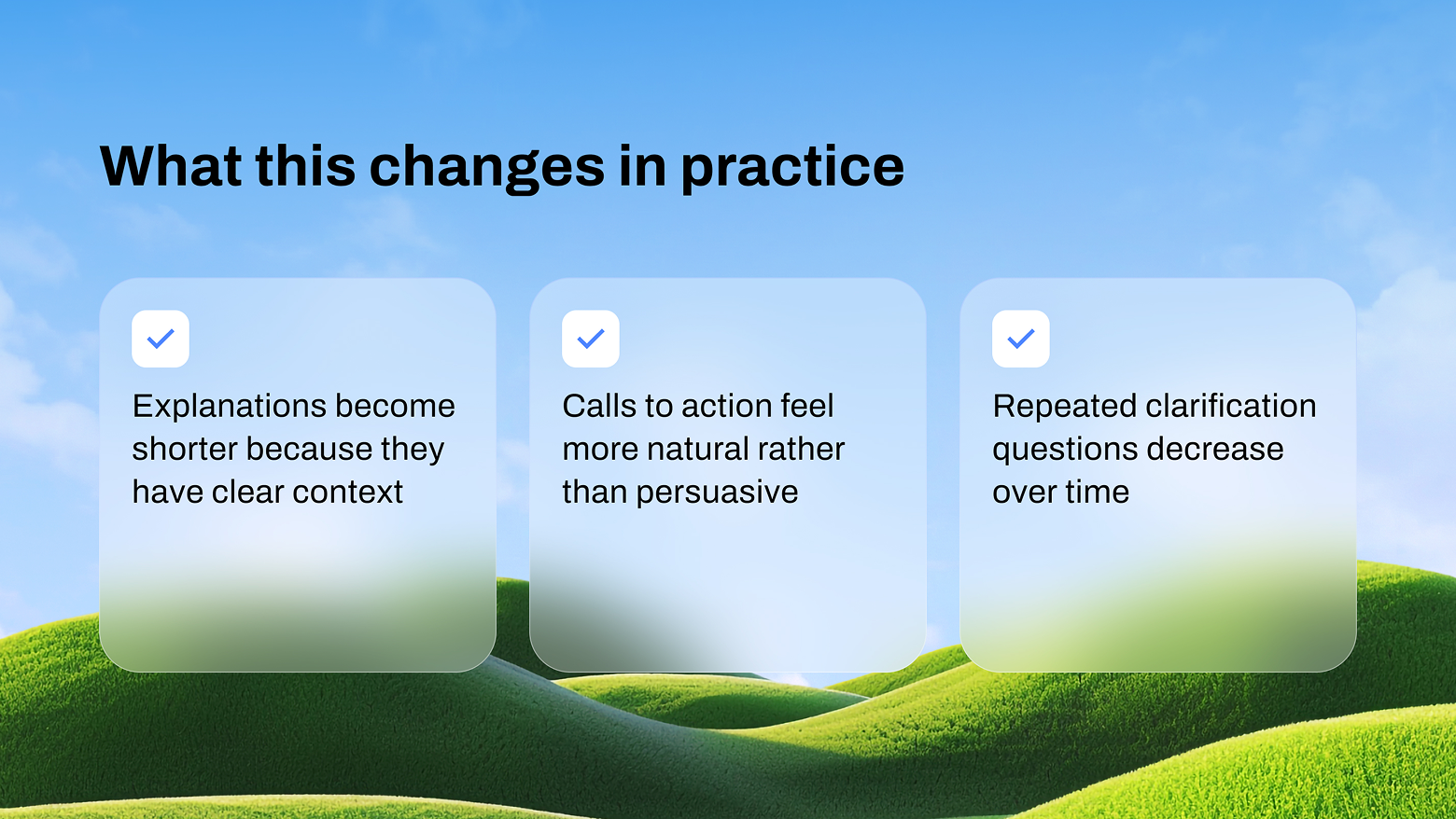
When messaging is shaped around decision points, explanations naturally become clearer and more focused.
For complex B2B products, that last signal is particularly meaningful.
5. Introduce motion and visual emphasis deliberately
Motion design can be an incredibly powerful tool, but it works best when the communication structure is already stable.
Designers often enjoy using animation to make interfaces more expressive, and when used thoughtfully it can guide attention, illustrate system relationships, and help users understand complex interactions.
However, when animation appears before the underlying message is clear, it tends to decorate uncertainty rather than resolve it.
We’ve seen teams spend weeks refining visual effects while the core narrative of the product was still evolving.
.png)
At that point motion becomes a reinforcement tool rather than a distraction.
Where to start after reading this
Pick the one item that feels most overdue and begin there. Not all ten at once, unless you’re feeling dangerously productive.
Company level
• Try writing your positioning in one paragraph as if explaining it to a new client today. It often reveals more than a full audit would
• Ask someone from sales and someone from delivery to describe the company in their own words. The differences are usually worth a conversation
• Think about one audience you’ve been quietly serving but never directly speaking to, and whether that’s still the right call
• Share your website with a new contact before your next call and ask what they took from it. The answer tends to be useful
Communication level
• Write down the one thing your website needs to make clear right now, then check whether the homepage actually does that
• Pick any two materials from different channels and read them together. Notice where the language starts to drift
• Look at your analytics dashboard and set aside any metric you haven’t acted on in a while. Fewer numbers often mean clearer thinking
• Read your most important page and try to name what the reader should do after it. If that takes a moment, the page might be worth revisiting
• Think back to the last few sales conversations and find the question that kept coming up. That’s usually the explanation worth fixing first
• Pick one visual element on the site and ask whether the page would feel any different without it. Sometimes the answer is surprisingly freeing
Why this sequence works
Across industries we rarely see marketing and design efforts stall because teams lack talent or effort. More often the difficulty appears when too many things are treated as equally urgent. Without a clear starting point, teams try to improve everything simultaneously: structure, messaging, branding, technology.
The result is a lot of movement, but not always a lot of progress.
Returning to this sequence helps restore orientation. It doesn’t impose a rigid process. Instead, it gives teams a shared starting point for deciding what matters first.
We continue applying the same thinking inside Sigma Software Design as our own work evolves.
Because even design teams occasionally need to step back and ask the same question we ask clients:
What actually needs to be clear first?